Crystals, Calcite, and Controversy: The Mineral Wealth Locked Inside America's Cave Systems
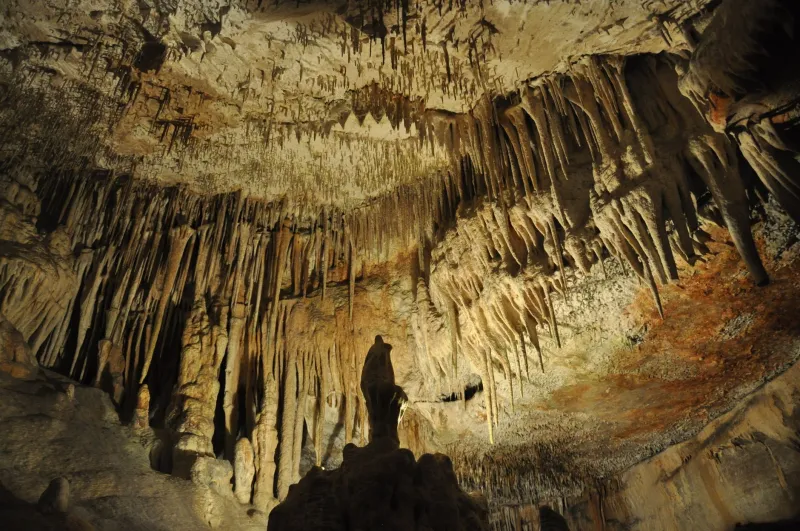
For most Americans, caves conjure images of stalactites dripping in torchlight, or perhaps the vast chambers of Carlsbad Caverns silhouetted against a tourist's camera flash. What fewer people appreciate is that many of these same cave systems contain mineral and gemstone deposits of genuine economic significance—formations that have been accumulating, undisturbed, for tens or even hundreds of thousands of years. As researchers expand their documentation of subterranean geology across the United States, they are confronting a fundamental tension: the very act of identifying these resources increases the pressure to exploit them.
What the Darkness Conceals
The geological processes that produce cave minerals are, at their core, a story about water and chemistry. As slightly acidic groundwater percolates through limestone and dolomite formations, it dissolves calcium carbonate and carries it into void spaces below. When that water encounters air, carbon dioxide escapes, and minerals begin to precipitate out of solution. Over millennia, this process yields the familiar speleothems—stalactites, stalagmites, flowstone—that define cave aesthetics for most visitors.
But the mineralogical inventory of American caves extends well beyond calcite. Selenite gypsum crystals, some exceeding six feet in length, have been documented in Lechuguilla Cave in New Mexico, a site widely regarded as one of the most mineralogically diverse cave systems on the planet. Aragonite formations, sulfur deposits, hydromagnesite moonmilk, and rare phosphate minerals have all been catalogued in caves stretching from the Ozark Plateau to the Appalachian highlands. In certain western states, cave systems intersect with ore-bearing geological strata, bringing silver, lead, and zinc mineralization into direct contact with speleothem environments.
Gemstone-quality specimens are less common but not unheard of. Cave pearls—concentrically layered calcite spheres formed in shallow pools—occasionally achieve gem-grade translucency. More commercially significant are the cave-associated fluorite deposits found in Illinois and Kentucky, where the mineral occurs in colors ranging from pale yellow to deep violet and has historically attracted both industrial and collector interest.
Lechuguilla and the Benchmark for Scientific Stewardship
No discussion of American cave mineralogy is complete without a sustained examination of Lechuguilla Cave, located within Carlsbad Caverns National Park in southeastern New Mexico. Discovered in its current extent only in 1986, Lechuguilla quickly became a landmark case study in how extraordinary mineral wealth and rigorous scientific protection can coexist—though not without ongoing negotiation.
The cave's sulfuric acid speleogenesis, a process driven by hydrogen sulfide rising from hydrocarbon deposits below rather than by descending rainwater, has produced formations found nowhere else on Earth. Pools of sulfuric acid have sculpted gypsum chandeliers, delicate anthodite crystal sprays, and vast deposits of hydrated calcium sulfate minerals across more than 145 mapped miles of passage. The National Park Service has restricted access to permitted scientific expeditions only, a policy that has drawn both admiration and criticism. Researchers argue the restriction has preserved the mineralogical integrity of the system; commercial interests have periodically questioned whether such exclusivity serves the broader public.
The Lechuguilla model has influenced management decisions at other significant sites, including Jewel Cave in South Dakota—the third-longest known cave in the world—where calcite crystal boxwork formations of unusual complexity continue to be documented by National Park Service geologists.
The Documentation Race
Across the country, speleological researchers are working against time to catalog mineral deposits before human activity—whether tourism, agricultural runoff, or direct extraction—alters cave chemistry irreversibly. The National Speleological Society coordinates much of this effort at the volunteer level, while federal agencies including the Bureau of Land Management and the U.S. Forest Service maintain their own cave inventory programs on public lands.
Digital documentation technologies have significantly accelerated these efforts. Three-dimensional laser scanning, portable X-ray fluorescence analyzers, and high-resolution photogrammetry now allow researchers to build detailed mineralogical records of cave passages without physical contact with the formations themselves. This non-destructive approach is considered essential in environments where a single misplaced handprint can introduce organic contamination that alters mineral deposition patterns for decades.
Dr. Diana Northup of the University of New Mexico, whose work on cave mineralogy and microbiology has spanned more than three decades, has described the documentation challenge in terms that resonate with many in the field: the geological record inside a pristine cave is, in many respects, more complete and more legible than anything available at the surface. Every formation carries chemical information about past climate conditions, hydrological shifts, and biological activity. Removing or contaminating a specimen does not merely deplete a resource—it erases a sentence from a document that took a hundred thousand years to write.
Extraction Ethics and the Collector Question
The legal framework governing cave mineral extraction in the United States is fragmented and, in some respects, insufficient. On federally managed public lands, the Federal Cave Resources Protection Act of 1988 prohibits the removal, damage, or destruction of cave resources without a permit. However, enforcement capacity varies significantly across jurisdictions, and the law does not extend to caves on private land, where a substantial portion of significant mineralogical deposits are located.
The collector market for cave minerals—particularly for large selenite crystals, cave pearls, and fluorite specimens—remains active, with high-quality pieces commanding prices in the thousands of dollars at mineral shows and through online dealers. Much of this material is legally obtained from private land or from international sources, but provenance verification is inconsistent, and the line between legally collected specimens and those removed from protected sites is not always clearly drawn.
Within the speleological research community, the prevailing ethical position is unambiguous: cave minerals should be studied in place wherever possible and removed only when a compelling scientific justification exists and proper permitting has been obtained. The Leave No Trace principles that govern surface recreation have their underground equivalent in the caver's code of conduct: take nothing but photographs, leave nothing but footprints—and in particularly sensitive environments, leave not even those.
Sustainable Tourism and the Visibility Problem
Commercially operated show caves represent a middle path of sorts, offering public access to underground mineral environments under controlled conditions. Operations such as those at Kartchner Caverns State Park in Arizona have invested substantially in climate-controlled entry systems and guided tour protocols designed to minimize the humidity and carbon dioxide fluctuations that can accelerate or disrupt mineral formation. These efforts demonstrate that economic viability and scientific stewardship are not inherently incompatible—provided that the initial investment in protective infrastructure is made and consistently maintained.
The broader challenge is one of visibility. The mineral wealth of American caves is largely invisible to the public precisely because it is inaccessible, and that inaccessibility is often what has preserved it. As documentation technologies improve and public interest in underground environments grows, the speleological community faces the ongoing task of communicating why these formations are worth more intact than extracted—scientifically, aesthetically, and ultimately, economically through the sustainable tourism they support.
The crystals growing in the darkness beneath the American landscape are not merely beautiful. They are records, laboratories, and, in the truest sense, irreplaceable. The question of who they belong to, and what obligations that ownership entails, is one that researchers, land managers, and the public will be navigating for generations to come.