Architects of the Abyss: How Cave Fauna Engineer the Nutrient Cycles That Sustain Underground Life
In the study of cave science, it is tempting to focus on the dramatic — the soaring stalagmites, the subterranean rivers, the crystalline formations that accumulate across geological timescales. Yet some of the most consequential processes unfolding inside America's cave systems are invisible to the naked eye: the slow, relentless transfer of organic matter from the surface world into the dark interior, driven not by geology but by biology. Specifically, by animals.
The organisms that inhabit caves — or that move between caves and the surface — function as living pipelines. They carry energy harvested from sunlit ecosystems into environments where photosynthesis is impossible, sustaining communities of microbes, invertebrates, and specialized fauna that would otherwise have no nutritional foundation. Researchers studying these dynamics have come to regard certain cave-dwelling species not merely as inhabitants but as active ecosystem engineers, whose behavioral patterns and metabolic outputs fundamentally determine what can survive in the dark.
The Guano Economy: Bats as the Backbone of Cave Food Webs
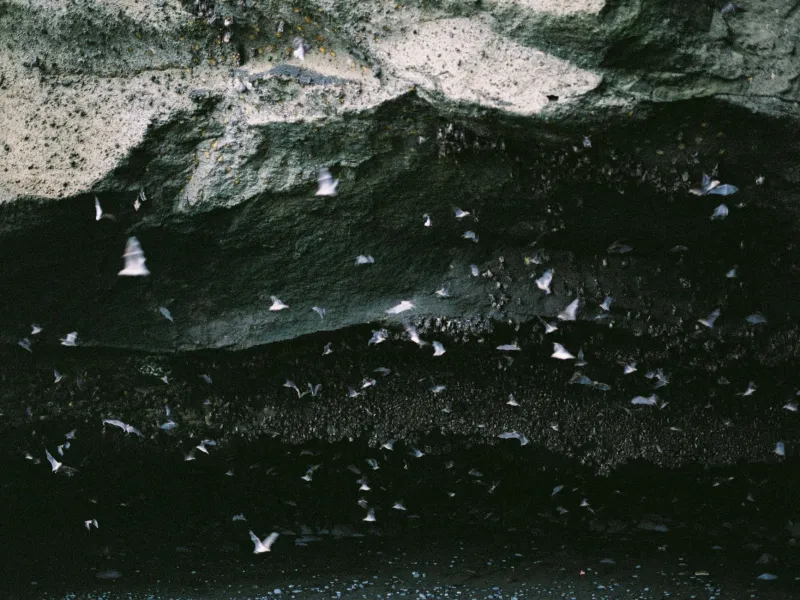
No organism has received more scientific attention in this context than the cave-roosting bat. Across the United States, dozens of bat species use cave systems as seasonal or year-round roosts, and in doing so they import enormous quantities of organic material in the form of guano — the accumulated fecal matter that can carpet cave floors in deposits meters deep in heavily colonized sites.
Guano is far more than waste. It represents a concentrated transfer of surface-derived nutrients: insects consumed in the foraging landscape above ground are metabolized, and their chemical constituents are deposited in a form that becomes the primary energy input for many cave ecosystems. Studies conducted at major bat colonies in the American Southwest and in the cave-rich landscapes of the Ozark Plateau have documented elaborate food webs anchored entirely to guano deposits. Specialized beetles, mites, fly larvae, and other invertebrates consume the guano directly, while predatory arthropods and cave-adapted salamanders prey upon those consumers in turn.
The microbial dimension is equally significant. Guano deposits host extraordinarily dense bacterial and fungal communities that drive decomposition, releasing nitrogen, phosphorus, and other compounds into the surrounding cave environment. These chemical outputs influence the water chemistry of cave streams and pools, with measurable downstream effects on aquatic invertebrate communities. In this sense, a single large bat colony does not merely occupy a cave — it chemically transforms it.
Cave Crickets and the Art of the Commute
While bats import nutrients through roosting and defecation, cave crickets — particularly species in the genus Hadenoecus, widespread across Appalachian and Midwestern cave systems — operate through a different mechanism. These insects are not permanent cave residents in the strictest sense. They commute. Emerging from caves at night to forage on the surface, they return before dawn, carrying within their bodies the organic compounds derived from surface plant matter and other insects.
When cave crickets defecate inside the cave, deposit eggs, or die and decompose, they introduce surface-derived nutrients into the subterranean environment. Research conducted in Kentucky's Mammoth Cave system — the longest known cave system in the world — has documented cave cricket populations that collectively transfer measurable quantities of organic carbon into cave passages on a nightly basis. The crickets themselves become prey for cave-adapted predators, including certain spider species and even some cave fish in flooded lower passages, creating trophic connections that link surface productivity directly to the deepest accessible portions of the system.
This commuting behavior makes cave crickets particularly sensitive indicators of surface habitat quality. Disruptions to the foraging landscape above — deforestation, agricultural conversion, pesticide use — can suppress cricket populations and, by extension, reduce the nutrient subsidy flowing into the cave. Researchers have begun examining these linkages as a framework for understanding how land-use changes above ground propagate into subterranean ecosystems.
Aquatic Pathways: Nutrients in Motion
Not all nutrient transfer in cave systems is mediated by animals moving on their own legs. Cave streams carry dissolved and particulate organic matter from surface soils and vegetation into the subterranean zone, and the invertebrate communities of cave streams — amphipods, isopods, crayfish, and others — process this material in ways that redistribute nutrients throughout the system.
Cave crayfish, present in numerous species across the cave systems of the Midwest and Southeast, are particularly active processors. As omnivores capable of consuming organic detritus, living prey, and biofilms, they occupy a central position in aquatic cave food webs and their movements physically transport nutrients between the water column and cave floor sediments. Studies of cave crayfish population densities have suggested that their abundance correlates with the organic richness of the water entering the system — a finding with implications for monitoring cave ecosystem health in real time.
When the Engineers Disappear: White-Nose Syndrome and Ecosystem Consequences
The fragility of these nutrient-cycling relationships has been thrown into sharp relief by the ongoing catastrophe of white-nose syndrome, the fungal disease caused by Pseudogymnoascus destructans that has killed an estimated six to seven million bats across North America since its detection in New York State in 2006. In caves where bat colonies have been severely reduced or eliminated, researchers have documented cascading effects on the guano-dependent communities that formerly thrived beneath the roosts.
Without the steady input of guano, invertebrate populations crash, microbial communities shift in composition, and the nutrient chemistry of affected cave passages changes measurably. Some researchers describe the phenomenon as a collapse of the cave's primary energy subsidy — the equivalent, in surface ecology, of removing the base of a food pyramid. Long-term monitoring at affected sites in Virginia, Pennsylvania, and Tennessee has revealed that recovery of the biological community does not follow automatically even in cases where bat populations begin to stabilize, suggesting that the disruption of nutrient cycling may have lasting structural effects on the ecosystem.
Climate Change and the Disruption of Biological Pipelines
Beyond disease, climate change introduces additional stressors to the animals that sustain cave nutrient cycles. Shifts in insect abundance and phenology on the surface affect the foraging success of cave-roosting bats and the nutritional quality of prey available to cave crickets. Altered precipitation patterns modify the hydrology of cave streams, changing the rate and composition of organic matter delivered to aquatic invertebrate communities.
Speleobiologists are increasingly concerned that cave ecosystems may be disproportionately vulnerable to climate-driven disruption precisely because their energy budgets are so tightly dependent on specific surface-to-subsurface linkages. A cave community adapted to a particular seasonal pulse of bat guano or cricket activity may have limited capacity to compensate if that pulse is reduced, delayed, or eliminated.
Toward a Systems Understanding of Cave Ecology
The emerging scientific consensus positions cave-dwelling and cave-visiting animals not as passive occupants of an underground landscape but as active participants in the construction and maintenance of the ecosystems they inhabit. This perspective has practical consequences for conservation. Protecting cave fauna cannot be separated from protecting the surface habitats that fuel the nutrient subsidies those animals provide.
For researchers and resource managers working across the cave-rich regions of the United States — from the karst terrain of the Ozarks to the limestone plateaus of the Appalachians to the lava tube systems of the Pacific Northwest — understanding the biological architecture of nutrient cycling may prove as important as mapping the physical architecture of the passages themselves. The cave is not merely a geological structure. It is a living system, and its vitality depends on the uninterrupted flow of energy from the world above.