Extremophiles in the Abyss: What Cave Microorganisms Are Teaching Us About the Boundaries of Life
For much of scientific history, life was understood to require a relatively narrow set of conditions: moderate temperatures, liquid water, accessible nutrients, and—above all—sunlight as an energy source. That understanding has been systematically dismantled over the past several decades, in large part because of what researchers have discovered growing in the most inhospitable corners of America's cave systems.
From the sulfuric acid pools of Lechuguilla Cave in New Mexico to the iron-rich drip water of limestone caverns in the Appalachians, microbial communities are not merely surviving in extreme underground environments—they are thriving. Their existence is forcing a fundamental reassessment of what the scientific community means when it uses the word "habitable."
A World Without Photosynthesis
The most striking characteristic of cave microbial ecosystems is their complete independence from solar energy. On the surface, nearly every food web on Earth traces its origins to photosynthesis. In the deep cave environment, that pathway does not exist. Instead, many cave microorganisms rely on chemolithotrophy—the metabolic process of extracting energy from inorganic chemical reactions rather than light.
In practice, this means that certain cave bacteria oxidize compounds such as hydrogen sulfide, ammonia, iron, or manganese to generate the energy required for cellular function. The resulting microbial mats—often visible as pale, filamentous structures coating cave walls and ceilings—represent entirely self-sustaining ecosystems built on geological chemistry rather than biological photosynthesis.
Lechuguilla Cave, a federally protected research site within Carlsbad Caverns National Park, has become one of the most intensively studied examples of this phenomenon. Its sulfuric acid speleogenesis—a process by which the cave itself was carved from below by rising hydrogen sulfide gas reacting with limestone—creates an environment of extraordinary chemical complexity. The microbial communities adapted to these conditions have attracted sustained attention from researchers at institutions across the United States.
Surviving the Unsurvivable
Beyond the absence of light, cave extremophiles routinely contend with conditions that would be lethal to most surface organisms. Researchers have documented microbial life persisting in cave environments with pH levels approaching 1—roughly equivalent to battery acid—as well as in systems where dissolved oxygen is nearly undetectable and available carbon is measured in parts per trillion.
Perhaps equally remarkable is the pace at which these organisms operate. Many cave microbes exhibit metabolic rates so slow that scientists have described them as existing in a state of near-suspended animation, dividing only once every several thousand years under the most nutrient-deprived conditions. This extreme metabolic parsimony represents an evolutionary strategy with no real analog in surface biology, and understanding its mechanisms has become a priority for researchers working at the intersection of microbiology and astrobiology.
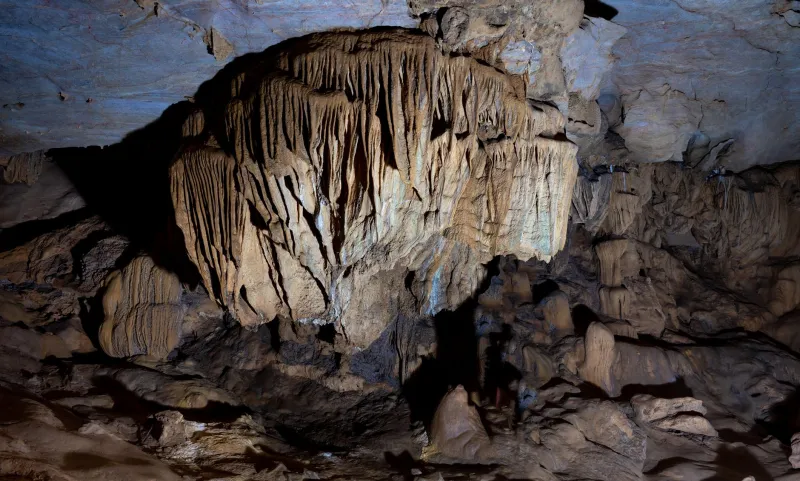
The microbial films that coat speleothems—the collective term for cave formations including stalactites, stalagmites, and flowstones—are now understood to play an active role in the geochemistry of the formations themselves. Rather than passive passengers on mineral surfaces, these microbial communities participate in the precipitation and dissolution of calcite and other minerals, effectively functioning as geological agents operating across timescales far longer than any individual organism's lifespan.
The Antibiotic Dimension
The pharmacological implications of cave microbiology have attracted considerable scientific and commercial interest. Because cave microorganisms have evolved in isolation from surface ecosystems—sometimes for millions of years—they have developed biochemical machinery, including novel secondary metabolites, that has no equivalent in the surface world.
Several research groups at American universities have identified cave-derived bacterial strains producing compounds with demonstrable antimicrobial activity against pathogens that have developed resistance to existing antibiotic classes. While the translation of these findings into clinical applications remains a lengthy and uncertain process, the underlying principle is scientifically compelling: evolutionary isolation produces biochemical novelty, and biochemical novelty is precisely what the global antibiotic resistance crisis demands.
The challenge for researchers is access. Many of the cave systems most likely to harbor undiscovered microbial diversity are also among the most fragile and difficult to reach. Contamination introduced during sampling can permanently compromise the integrity of a site, and the logistical demands of conducting rigorous microbiological fieldwork in remote cave environments require specialized training that bridges speleology, microbiology, and analytical chemistry.
Implications for the Search for Extraterrestrial Life
The broader significance of cave extremophile research extends well beyond Earth's surface. As NASA and international space agencies direct increasing scientific attention toward subsurface environments on Mars, Europa, and Enceladus, the cave microbiome has emerged as one of the most scientifically credible analogs for potential extraterrestrial habitats.
Mars, for instance, is now understood to have hosted liquid water for extended periods in its geological past, and evidence suggests that subsurface brines may persist in certain locations today. If microbial life ever existed on Mars, the subsurface—shielded from the planet's intense ultraviolet radiation and oxidizing surface chemistry—represents the environment most likely to have preserved it. America's cave extremophile research provides a working biological model for exactly the kind of chemolithotrophic, low-energy microbial communities that might theoretically persist in such conditions.
Similarly, the subsurface oceans hypothesized beneath the icy crusts of Europa and Enceladus are environments defined by darkness, pressure, and chemical energy sources—conditions that map closely onto the deep cave systems being studied in the American Southwest and elsewhere. The metabolic strategies documented in cave microorganisms are therefore informing the design of biosignature detection protocols for future planetary missions.
The Methodological Frontier
Studying cave microbiomes presents formidable technical challenges. Traditional culture-based microbiological methods are largely ineffective for cave organisms, the majority of which cannot be grown under laboratory conditions. The field has consequently become an early adopter of metagenomic sequencing—the direct analysis of genetic material extracted from environmental samples without the need to culture individual organisms.
This approach has revealed that the microbial diversity of cave systems is vastly greater than culture-based surveys suggested, with many cave environments harboring taxonomic lineages with no close relatives in any other known ecosystem. The functional capabilities encoded in these novel genomes—the enzymes, metabolic pathways, and stress-response mechanisms that allow cave microbes to persist where nothing else can—represent an untapped reservoir of biochemical knowledge.
Researchers at several American universities and federal agencies, including the U.S. Geological Survey, are currently developing standardized protocols for cave microbiome sampling that minimize contamination while maximizing the diversity of organisms captured. The long-term goal is a comprehensive catalog of American cave microbial diversity that can serve as both a scientific baseline and a conservation reference as these fragile ecosystems face growing pressure from climate change and increased human visitation.
Life Redrawn
The cumulative weight of cave microbiome research has done something that few areas of science accomplish: it has required a genuine redrawing of the map. The boundaries of life, as understood by biology, now extend into territories that would have seemed implausible a generation ago. Organisms thrive in the dark, in the acid, in the near-vacuum of nutrients, and in the geological slowness of deep time.
For speleologists, microbiologists, and astrobiologists alike, the American cave system has become one of the most productive laboratories on Earth—not despite its extreme conditions, but precisely because of them. What lives in the darkness beneath our feet may ultimately tell us more about the nature of life itself than almost anything we have found in the light above.